
Log a trade step by step
The heart of ChimTradeApp is the journal: every XAUUSD position you record feeds your statistics and reports. Here is how to enter a complete trade, field by field, and why you should do it right after the trade, while it is still fresh.
7 min read
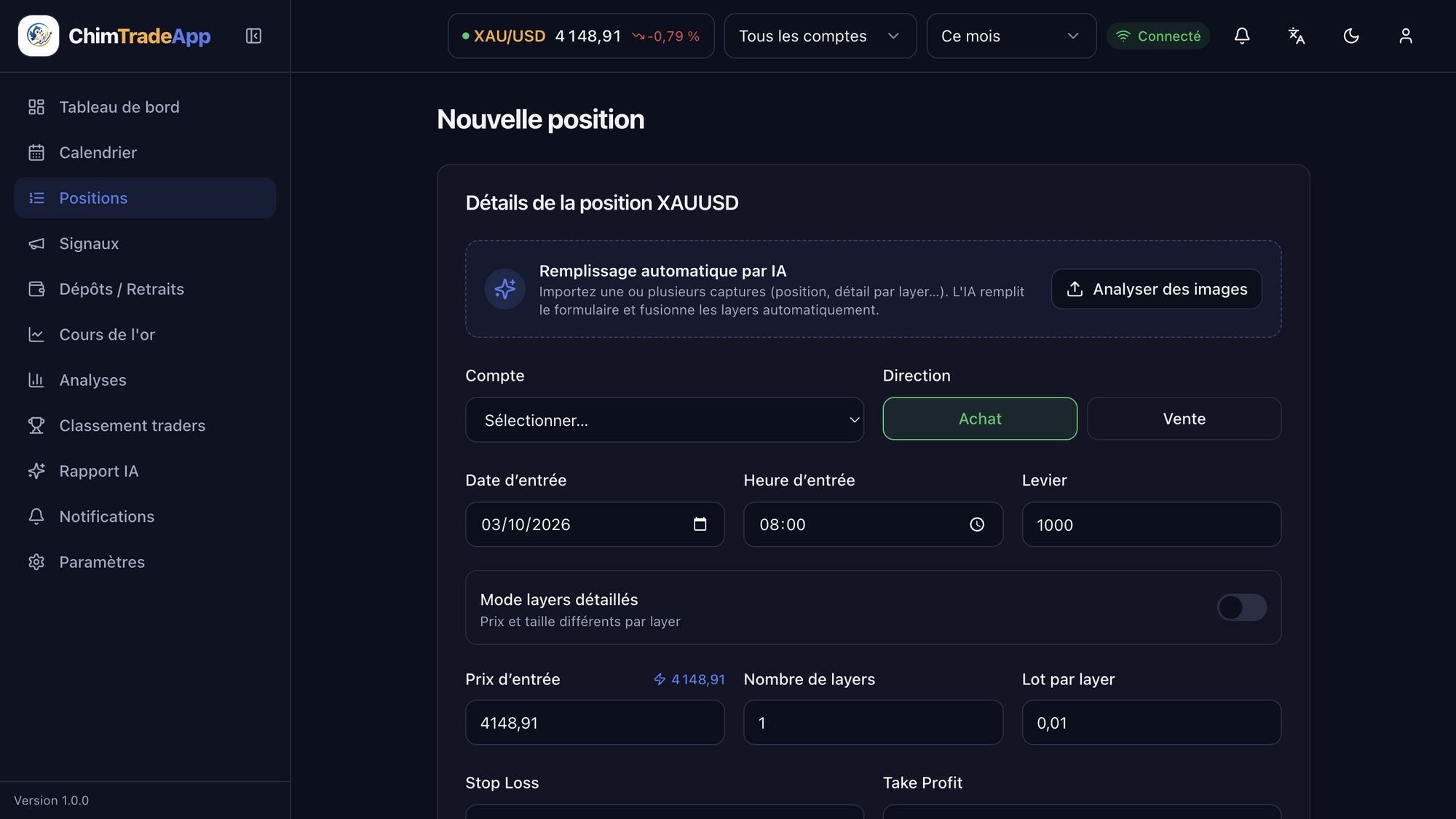
Setup
Make sure you have created your account and a trading account. Then, three paths lead to the form:
- Positions page → New position button;
- Calendar page → the "+" of a session cell, which pre-fills the date and time;
- The position is always recorded on the XAUUSD instrument: that is the app's specialty.
Steps: fill in the form
- Account: select the relevant trading account (demo, live…).
- Direction: choose Buy (you are betting on gold rising) or Sell (on it falling).
- Entry date and time: the exact moment you opened the position. The app automatically infers the session (Asia, London, or US) from your configured hours.
- Entry price: the price at which you entered. Tip: the Current price button inserts the live gold price — handy for a position that was just opened.
- Size: enter the Lot per layer (0.01 for a micro-lot) and the Number of layers if you entered several times at the same price. Enable Detailed layers mode if each layer has a different price: you then enter the price and lot of each layer.
- Leverage: the one used for the position (pre-filled with the account's default leverage).
- Stop Loss and Take Profit: the planned protection and target levels. They let the app compute your planned risk and your risk/reward ratio.
- Result: leave it Open while the position is running. When it is finished, choose Take Profit, Stop Loss, Break Even, or a manual result: the exit fields then appear.
- Exit: closing date, time, and price. If you select Take Profit or Stop Loss, the exit price is pre-filled with the corresponding level — correct it if execution slipped. Fees and swap can be added for an exact net PnL.
- Context: fill in the Strategy, the Setup, the Signal source (your own or a service you follow), Tags, and your Confidence from 1 to 5. These are the fields that will make your per-strategy analytics useful.
- Notes: describe the reason for the trade and your mindset. You can also import your chart screenshot via Import chart: the AI writes an analysis that you can adjust.
- Click Save position. If a very similar position already exists, an anti-duplicate warning tells you before saving.
Save time with image analysis
At the top of the form, the AI auto-fill block accepts one or more screenshots from your platform (position, per-layer details): drag them into the zone or click Analyze images. The AI fills in direction, prices, layers, stop loss, and take profit, and merges the screenshots together. Always check the fields before saving.
Open or closed positions
An Open position has no exit date and no PnL: it appears in your journal and on the Gold price chart, but it does not yet count in your performance statistics. Return to the position (Positions page → click it → Edit) as soon as it closes to enter the result: this discipline is what guarantees reliable statistics.
Why journal while it is fresh?
- Faithful memory: a few hours later, you will have forgotten why you entered — yet that "why" is precisely what needs analyzing.
- Emotion detection: noting your confidence and notes right away later reveals your patterns (FOMO, revenge trading).
- Accurate statistics: an incomplete journal produces a distorted win rate and profit factor.
Key takeaways
- Each position takes less than a minute to enter: account, direction, entry, lots, SL/TP.
- The Current price button and AI screenshot analysis speed up data entry.
- Open while the trade runs, then result and exit at close.
- Journal immediately after every trade, without exception.
Next, learn to use this data: analyze your performance.
Go from theory to practice
Open an account with our partner broker XM to trade GOLD/USD, then log every trade in ChimTradeApp to analyze your results and keep improving.
Affiliate link: we earn a commission at no extra cost to you. Trading involves a risk of capital loss.